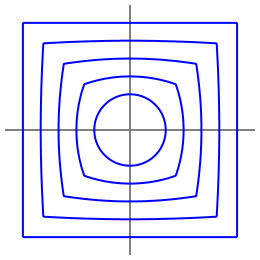
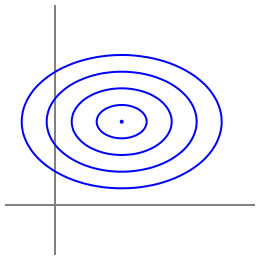
Technically, this is the assumption on \(h\text{:}\)
\begin{equation*}
h(t,s) = \begin{cases}h_1(t,s) \amp \text{ if } 0 \le t \le
t_1 \, , \\ h_2(t,s) \amp \text{ if } t_1 \le t \le t_2 \, ,
\\ \vdots \\ h_n(t,s) \amp \text{ if } t_{ n-1 } \le t \le 1
\, , \end{cases}
\end{equation*}
where each
\(h_j(t,s)\) has continuous second partials. (
Example 4.3.2 gives one instance.) Now we turn to the proof under these extra assumptions.
For \(0 \leq s \leq 1\text{,}\) let \(\gg_s\) be the path parametrized by \(h(t,s), \ 0 \leq
t \leq 1\text{.}\) Consider the function \(I: [0,1] \to \C\) given by
\begin{equation*}
I(s) \ := \ \int_{ \gg_s } f \,\text{,}
\end{equation*}
so that
\(I(0) = \int_{\gg_0} f\) and
\(I(1) = \int_{\gg_1} f\text{.}\) We will show that
\(I\) is constant; in particular,
\(I(0) = I(1)\text{,}\) which proves the theorem. By Leibniz’s rule (
Theorem A.0.9),
\begin{align*}
\frac{d}{\diff{s}} I(s) \ \amp = \ \frac{d}{\diff{s}}
\int_0^1 f \left(h(t,s) \right) \frac{ \partial h }{\partial t
} \, \diff{t} \ = \ \int_0^1 \frac{\partial}{\partial s}
\left( f \left( h(t,s) \right) \frac{\partial h }{\partial t }
\right) \diff{t}\\
\amp = \ \int_0^1 \left( f' \left( h(t,s) \right) \frac{
\partial h }{ \partial s } \frac{ \partial h }{ \partial t } +
f \left( h(t,s) \right) \frac{ \partial^2 h }{ \partial s \,
\partial t } \right) \diff{t}\\
\amp = \ \int_0^1 \left( f' \left( h(t,s) \right) \frac{
\partial h }{ \partial t } \frac{ \partial h }{ \partial s } +
f \left( h(t,s) \right) \frac{ \partial^2 h }{ \partial t \,
\partial s } \right) \diff{t}\\
\amp = \ \int_0^1
\frac{\partial}{\partial t} \left( f \left( h(t,s) \right)
\frac{\partial h}{\partial s} \right) \diff{t} \, \text{.}
\end{align*}
Note that we used
Theorem A.0.7 to switch the order of the second partials in the penultimate step—here is where we need our assumption that
\(h\) has continuous second partials. Also, we needed continuity of
\(f'\) in order to apply Leibniz’s rule. If
\(h\) is piecewise defined, we split up the integral accordingly.
Finally, by the Fundamental Theorem of Calculus (
Theorem A.0.3), applied separately to the real and imaginary parts of the above integrand,
\begin{align*}
\frac{d}{\diff{s}} I(s) \amp \ = \ \int_0^1
\frac{\partial}{\partial t} \left( f \left( h(t,s) \right)
\frac{\partial h}{\partial s} \right) \diff{t}\\
\amp \ = \ f(h(1,s))
\, \frac{\partial h}{\partial s} (1,s) - f(h(0,s)) \,
\frac{\partial h}{\partial s} (0,s)\\
\amp \ = \ 0 \,\text{,}
\end{align*}
where the last step follows from \(h(0,s) = h(1,s)\) for all \(s\text{.}\)